
TL;DR:
- Trustworthy platforms verify identities, protect property, and offer safety features for secure exchanges.
- Detailed reviews and high-quality listings help assess property condition and host reliability.
- Paid membership platforms with active communities generally provide more accountability and better support.
Finding a trustworthy home exchange platform can feel genuinely overwhelming, particularly if you’re travelling as a family or working remotely from someone else’s home. With dozens of services competing for your attention, it’s easy to focus on price or location and overlook the features that actually determine whether your swap will be safe, smooth, and satisfying. The right platform does far more than list homes: it verifies identities, protects your property, supports you when things go unexpectedly, and connects you with a community of like-minded travellers. This guide breaks down the essential features to look for, so you can make a confident, well-informed choice.
Table of Contents
- Verification and trust: building a safe foundation
- Authentic experiences through user reviews and ratings
- High-quality listings: what details matter most?
- Safety, support, and insurance: non-negotiables for peace of mind
- Flexibility and community: exchange models, support, and special cases
- Our perspective: what most home exchange guides leave out
- Ready to swap? Discover a trusted home exchange community
- Frequently asked questions
Key Takeaways
| Point | Details |
|---|---|
| Verification first | Always choose platforms with ID and home verification to maximise safety and trust. |
| Read the reviews | Prioritise listings with plenty of recent, detailed user feedback before making decisions. |
| Listing quality matters | Strong, photo-rich listings with full amenity details set expectations and boost satisfaction. |
| Don’t skip insurance | Platform damage protection and support services are vital for peace of mind. |
| Seek flexibility | Choose platforms that support points, credits, or community-driven swaps for easy matching. |
Verification and trust: building a safe foundation
Trust is the currency of home exchange. When you hand over your keys to a stranger, or step into someone else’s home with your children or your laptop, you need more than a pleasant profile photo to feel confident. Robust verification is the single most important feature any platform can offer.
Reputable platforms require identity and home verification processes, including government-issued ID checks, proof of address or home ownership, and visible badges on verified profiles. These aren’t optional extras; they are the baseline standard for any platform worth your time. Automated onboarding systems that cross-reference documents add an additional layer of reliability, reducing the risk of fraudulent listings or misrepresented properties.
For families, the stakes are especially high. Knowing that every host has been vetted before you arrive with young children provides genuine reassurance. Remote workers, too, need confidence that the home they’re booking actually exists and matches its description, particularly when planning a month-long working stay abroad. Following a thorough verification checklist for home swappers before committing to any exchange is a sound habit.
Here’s what to look for when assessing a platform’s verification standards:
- Government-issued ID confirmation for all registered members
- Proof of address or property ownership before a listing goes live
- Visible verification badges on both host and property profiles
- Automated onboarding that flags incomplete or suspicious submissions
- Platform terms and safety procedures that are clearly published and easy to find
Understanding how home exchange verification works on your chosen platform before you list or book is essential. Free, unverified services may look attractive, but they invite considerably more risk and far less accountability.
Pro Tip: Always check whether a platform displays verification status separately for both the host and the property. A verified person living at an unverified address is only half the picture.
Authentic experiences through user reviews and ratings
Verification sets a strong foundation, but real traveller experiences can reveal details you won’t find in a listing. A beautifully written description tells you what a host wants you to know; a collection of honest reviews tells you what previous guests actually experienced.
Platforms with strong review cultures produce 4.7-star ratings from 15,000+ reviews, which serves as a useful industry benchmark. When evaluating any platform, look beyond the headline score. A high average rating based on only a handful of reviews is far less meaningful than a consistent score built over hundreds of exchanges.
When reading individual reviews, look for these specific signals:
- Cleanliness and condition of the property on arrival
- Accuracy of the listing compared to what guests found
- Communication quality before and during the stay
- Local tips and neighbourhood insights shared by the host
- Recency of reviews, ideally within the past 12 months
The following table illustrates what a strong versus weak review profile looks like when browsing platform ratings and reviews:
| Review indicator | Strong profile | Weak profile |
|---|---|---|
| Total review count | 20 or more | Fewer than 5 |
| Average rating | 4.5 stars or above | Below 4.0 stars |
| Review recency | Within the past year | Older than 2 years |
| Detail and specificity | Mentions rooms, WiFi, local area | Generic praise only |
| Host responses | Prompt and constructive | Absent or defensive |
Post-exchange reviews function as the strongest mutual trust signal on any platform. They create accountability on both sides: guests are motivated to treat a home with respect, and hosts are motivated to present their property honestly. Third-party home exchange reviews can also supplement what you find on the platform itself, offering an independent perspective that isn’t filtered by the service.
“A listing with fifty detailed, recent reviews tells a far richer story than a perfect score from three friends. Volume and specificity are what build real confidence.”
High-quality listings: what details matter most?
Once you trust a platform and its users, it’s time to analyse individual homes. The quality of a listing signals how seriously a host takes the exchange, and it directly affects whether your stay will match your expectations.
Professional images attract up to 3x more enquiries than listings with amateur or missing photos. That statistic alone should tell you how much presentation matters. But photographs are only the starting point.

For families and remote workers especially, the written details carry just as much weight. A listing that specifies WiFi download speeds, mentions a dedicated workspace, confirms whether a cot is available, or notes the proximity of a supermarket is far more useful than one that simply says “comfortable home with garden.”
Here’s a quick comparison of what separates a high-quality listing from an average one:
| Feature | High-quality listing | Average listing |
|---|---|---|
| Photography | Professional, well-lit, multiple rooms | One or two phone snapshots |
| WiFi information | Speed confirmed, provider named | “WiFi available” |
| Workspace details | Desk, chair, monitor described | Not mentioned |
| Family amenities | Cot, highchair, stair gate listed | Vague or absent |
| Neighbourhood info | Shops, transport, schools noted | “Nice area” |
| Last updated | Within 6 months | Unknown or years ago |
For remote workers, listing essentials go beyond square footage. Reliable internet and a quiet workspace are non-negotiable requirements, not nice-to-haves. When browsing, always check when a listing was last updated, and don’t hesitate to message the host directly to confirm specifics.
Pro Tip: Before finalising any exchange, review guidance on how to photograph your home for a swap so your own listing attracts equally well-prepared guests.
Beware of listings that use vague language, show only exterior shots, or haven’t been updated in over a year. These are reliable indicators that the host may not be actively engaged with the platform.
Safety, support, and insurance: non-negotiables for peace of mind
Having scrutinised amenities and listed features, the last thing you want is an unexpected emergency or dispute without a safety net. Safety infrastructure is where many platforms fall short, and where the difference between a stressful experience and a seamless one is most clearly felt.
Before confirming any swap, run through this safety checklist:
- Smoke detectors and carbon monoxide alarms confirmed present
- Emergency contacts provided by the host in writing
- First aid kit available on the property
- Neighbourhood safety information included in the listing or shared directly
- Secure entry arrangements confirmed before arrival
On the insurance side, leading platforms offer property damage protection up to $1,000,000, though the deductible and specific terms vary. Read the fine print carefully. Some platforms cap claims, exclude certain categories of damage, or require you to report incidents within a tight timeframe. Your own homeowner’s insurance policy may also need to be reviewed before hosting.
Platforms that report fewer than 1% serious incidents among exchanges consistently do so because they combine insurance with active moderation and clear dispute resolution processes. That’s not a coincidence. Checking home swap safety statistics across different services gives you a realistic picture of what to expect.
Always communicate and pay through official platform channels. Never take conversations off-platform, and never transfer money directly to a host. If a platform lacks 24/7 support or a clear escalation process, treat that as a serious warning sign.
Flexibility and community: exchange models, support, and special cases
After covering safety, it’s worth examining how flexibility and a supportive community make home swapping genuinely accessible for people with varied schedules and needs.
Not every traveller can arrange a perfect date match with another household. That’s why the exchange model a platform uses matters enormously. The three main types are:
- Simultaneous exchanges: both parties swap homes at the same time, ideal when schedules align perfectly.
- Non-simultaneous exchanges: parties swap at different times, requiring a higher degree of mutual trust and coordination.
- Points or credits-based models: hosts earn credits by welcoming guests, then spend those credits on future stays elsewhere, removing the need for matched dates entirely.
A credits system, such as SwapCredits on SwapSpace, is particularly well suited to busy families and digital nomads who travel frequently but unpredictably. Annual memberships costing between $150 and $250 enable unlimited swaps, which represents extraordinary value compared to hotel or short-term rental costs for frequent travellers.
Platforms that offer all three exchange types explained give you the widest possible range of options. Equally important is the community around the platform. Active forums, responsive member support, and curated resources for niche users such as families with young children or full-time remote workers signal that a platform is genuinely invested in its members’ success.
Pro Tip: Platforms with paid membership structures and active community moderation consistently produce more reliable exchanges than free services. The membership fee filters for serious, committed users.
Exploring home exchange membership savings in practice often reveals that even a modest annual fee pays for itself after a single successful swap.
Our perspective: what most home exchange guides leave out
Most articles about home exchange focus on the headline benefits: free accommodation, authentic local experiences, and the joy of travelling differently. What they rarely address is the structural difference between paid, verified platforms and their free counterparts, and why that difference matters far more than most guides acknowledge.
Free platforms may appear attractive, but they attract a wider range of users, not all of whom are equally serious or accountable. Recurring disputes and the occasional scam almost always originate from unverified, poorly moderated networks where there is little consequence for bad behaviour.
Paid platforms filter serious users more effectively, and the combination of identity verification, insurance, and active support creates an environment where trust can genuinely develop. Experienced swappers consistently report higher satisfaction on platforms where guidelines, insurance, and community standards are built into the membership.
The most overlooked piece of advice? Be proactive about communication before every exchange. A brief video call, a shared document of house rules, and a direct conversation about expectations will resolve more potential issues than any insurance policy. Choosing the right exchange platform is the first step; investing in the relationship with your swap partner is what makes the experience genuinely rewarding.
Ready to swap? Discover a trusted home exchange community
If you’ve been weighing up the features covered in this guide and wondering where to find a platform that genuinely delivers on all of them, SwapSpace is worth exploring.
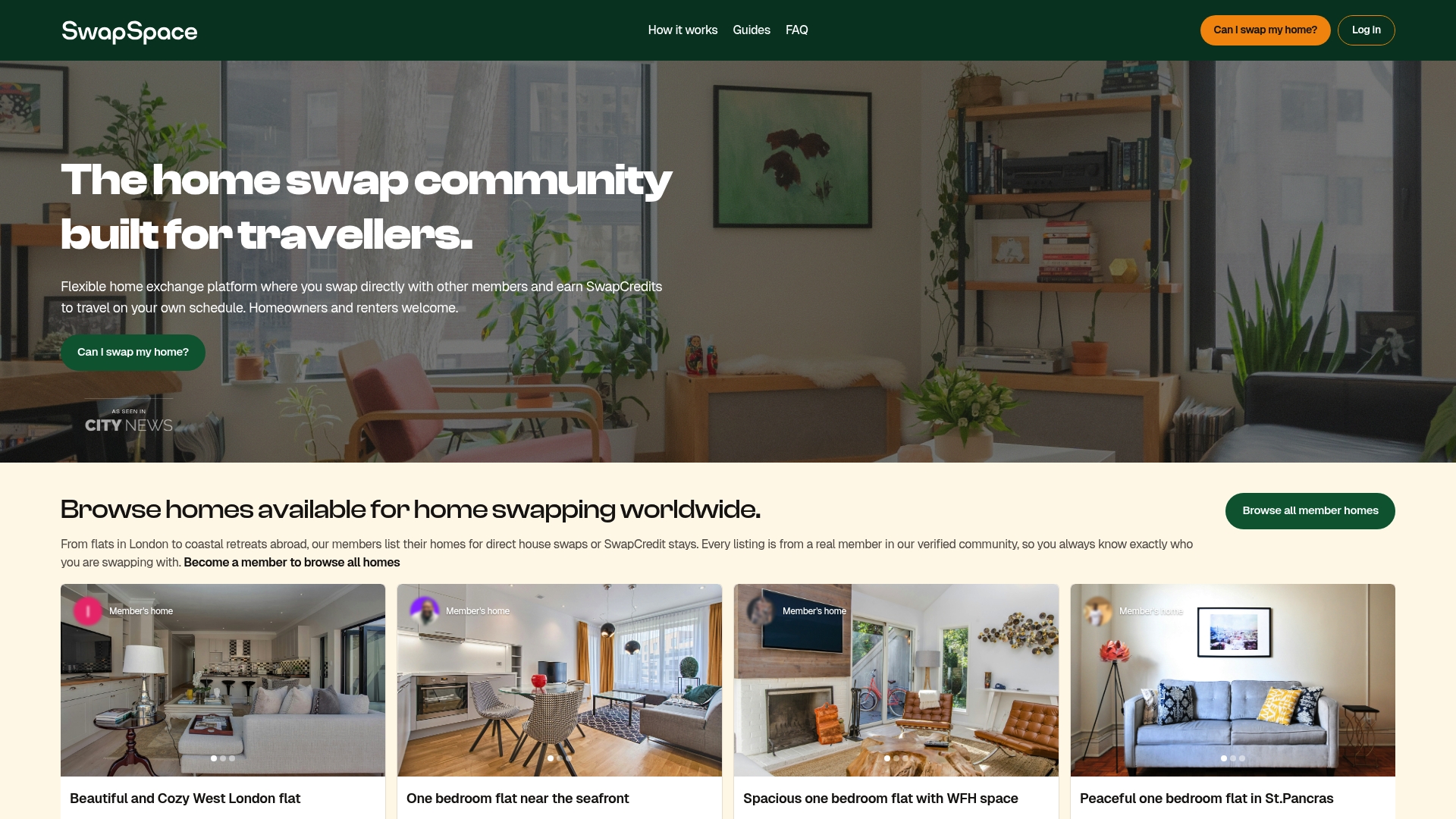
SwapSpace is built around verified member profiles, transparent listings, and a flexible SwapCredits system that removes the pressure of matching dates perfectly. There are no hidden fees, and the community is invite-only, which means every member has been reviewed before joining. Whether you’re a family planning a summer trip, a remote worker seeking a month abroad, or a retiree ready to explore, you can join SwapSpace and start browsing homes today. Learn more about how SwapSpace works or get your listing started with guidance on how to photograph your home for a winning listing.
Frequently asked questions
What’s the most important feature when choosing a home exchange platform?
Verified user and property profiles are the most critical feature, as they establish the trust and safety that every successful exchange depends on. Without rigorous identity and home verification, no other feature can fully compensate.
How does home exchange differ from vacation rentals like Airbnb?
Home exchange involves swapping homes without any payment changing hands, typically within a community-moderated platform that uses simultaneous, non-simultaneous, or credits-based models. Commercial rental platforms like Airbnb operate as transactional marketplaces with less emphasis on reciprocal community trust.
Is my home insured during a home swap?
Many leading platforms offer property damage protection up to $1,000,000, but the specific terms, deductibles, and exclusions vary by platform. Always read the insurance policy in full and check whether your existing homeowner’s insurance also applies.
How are disputes handled or support provided?
Top platforms offer 24/7 support and fraud protection alongside written swap agreements that set clear expectations for both parties. Choosing a platform with a transparent escalation process is essential before your first exchange.
Which platform types are best for flexible or non-traditional swaps?
Points and credits-based platforms offer the greatest flexibility for travellers who cannot match dates directly with another household. They allow you to host independently and redeem credits for future stays at your own convenience.