Family travel on a budget usually gets framed as a game of smaller savings. Bring snacks. Book on a Tuesday. Skip the souvenir shops. Those tactics help, but they rarely change the shape of a trip. The bigger lever is accommodation, because that’s where family travel becomes expensive fast. Bigger rooms, extra beds, kitchen access, location, and school-holiday demand all push the bill upwards.
That pressure is showing up clearly in current family travel behaviour. In 2024, the average American family spent about $8,052 on travel, up 20% from 2023, while 73% of parents said affordability was their biggest barrier to travelling as a family, according to the 2025 Family Travel Survey. Families still want to go. They are looking for a smarter structure.
That’s why home swapping deserves more attention than it usually gets. Done well, it can remove the largest travel cost while giving families more space, a kitchen, and a neighbourhood that feels lived in rather than staged for tourists. If you’re thinking seriously about family travel on a budget, the most important decision isn’t which destination to pick first. It’s which home exchange platform you trust enough to use.
If you’re also weighing the cost of big-ticket family favourites, this guide on how to save money at Disneyland is worth a look. But for most trips, choosing the right swap site is the decision that changes the maths.
Table of Contents
- 1. 1. Verified Profiles The Foundation of Trust
- 2. 2. Flexible Swaps Travel on Your Own Terms
- 3. 3. Transparent Pricing No Hidden Fees
- 4. 4. A Genuine Community More Than Just a Listing Site
- 5. 5. Effortless to Use A Platform That Simplifies Travel
- 5. 5. Effortless to Use A Platform That Simplifies Travel
- 5-Point Comparison: Budget Family Travel Features
- Your Checklist for Smarter Family Travel
1. 1. Verified Profiles The Foundation of Trust
Who are you trusting with your family trip?
That question sits at the centre of home exchange, and it matters even more on trips involving children, grandparents, or both. Multi-generational travel has become a clear priority for many families. Hilton's 2025 Trends Report notes growing demand for trips that bring several generations together. Once a trip includes different sleep routines, mobility needs, and expectations around space, a vague profile is not enough.
Choosing the right platform starts here. Verification is not a small safety feature tucked away in the account settings. It is one of the main reasons a home exchange can save a family money without adding risk. If the profiles are weak, the cheaper accommodation is rarely worth the uncertainty.
Why verification matters more for families
A strong platform checks identity properly and shows that status clearly on every listing. Government ID verification, confirmed contact details, and visible profile completion all help you judge whether a home is being offered by a real household that takes the exchange seriously.
For families, that changes more than the security question. It improves the quality of the match. Parents need to know whether the host understands practical details such as cot availability, stair gates, blackout blinds, parking, laundry, and how far the nearest grocery shop really is. Grandparents often need clarity on stairs, walk-in showers, lift access, or whether the walk to the beach is flat or steep. Verified profiles tend to produce better conversations because there is a real person behind them, not a polished but thin listing.
It also saves time.
I have found that the best exchanges are usually agreed quickly because both sides have done the basic work up front. Clear identity checks reduce the back-and-forth that often makes families give up and book a hotel instead.
What a strong profile should include
Verification is the starting point, not the whole job. A useful family profile should show recent photographs of the home, honest descriptions of bedrooms and bathrooms, and practical notes that matter once you arrive tired with children in tow. Platforms that encourage members to follow clear home photo guidelines for exchange listings usually produce better profiles because the images answer real questions instead of just selling the space.
Look for profiles that include:
- sleeping arrangements by room, not just total guest numbers
- kitchen details that matter to families, such as a freezer, high chair, or microwave
- child-specific items, if they are offered
- accessibility notes for older relatives or anyone with limited mobility
- house rules written in a calm, specific way
- reviews that mention communication, cleanliness, and accuracy
There is a trade-off here. The most reassuring profiles can feel less glossy because they show the home plainly. That is often a good sign. Families travelling on a budget do not need fantasy. They need to know whether everyone will sleep well, eat easily, and settle in without expensive workarounds.
On a good home exchange platform, trust is built before the first message is sent. That is what makes the savings usable, not just theoretical.
2. 2. Flexible Swaps Travel on Your Own Terms

What saves a family more money in practice: shaving £20 off a flight, or choosing a home exchange platform that does not force everyone into the same dates?
For many families, the biggest budget decision is not where to cut corners. It is whether the platform gives you more than the old one-week-for-one-week swap. Direct exchanges still have their place, but family travel rarely fits that tidy model. Term dates, shared custody arrangements, shift work, exam periods, and grandparents joining for part of the trip all make exact date matching harder than it sounds.
That is why flexible exchange systems matter. A platform that allows non-simultaneous swaps or points-based stays gives families room to plan around real life instead of abandoning the idea and booking costly peak-season accommodation.
Why flexibility matters more than small savings tips
The classic direct swap works well when two households want the same destination at the same time. That happens. It is not the pattern I would build a family travel budget around.
A stronger option is a platform that lets you host at one point in the year and travel at another. That changes the economics of the trip. You are no longer limited to the rare moment when your calendar aligns perfectly with another family whose home also suits your needs. You can build value over time, then use it when fares are lower, school schedules are manageable, or extended family can join.
That flexibility is especially useful for bigger groups. A family travelling with grandparents may need a ground-floor home, extra bedrooms, and dates that fit several households. Finding all of that in a straight swap is possible, but it takes longer and often pushes people back toward hotels or holiday rentals.
The feature to look for
Check how the platform handles indirect exchanges before you commit. A good explanation of how flexible home exchanges work should make clear whether you can arrange non-reciprocal stays, earn credits or guest points, and book without needing another family to travel on your exact dates.
That is the feature that turns home exchange from an appealing idea into a usable family budget tool.
In practice, flexible swaps help families do three things well:
- travel in shoulder season while keeping the benefit of a full home
- split trips between households or generations without forcing one exact exchange window
- say yes to shorter breaks, not only long summer holidays
There is a trade-off. The most flexible systems can require more planning upfront, and some families prefer the simplicity of a direct one-to-one arrangement. But if the goal is to make family travel affordable more than once, flexibility usually beats perfection. The right platform gives you options, and options are what keep costs under control when family calendars start pulling in different directions.
3. 3. Transparent Pricing No Hidden Fees

How often does a cheap family break stay cheap once you reach checkout?
Families know the pattern. A reasonable nightly rate turns into a much larger bill once service charges, cleaning fees, extra guest fees, and local taxes are added. For parents trying to keep a trip within a clear budget, that uncertainty is the problem as much as the final price.
Accommodation and food do most of the damage to a family travel budget. The USDA food plans show how quickly meal costs add up even at home. Once you are travelling, eating every meal out pushes the total higher again. That is why the right home exchange platform matters more than another round of minor savings tips. It changes the biggest line on the budget, not the smallest.
A good exchange platform makes the cost structure plain from the start. You should be able to see the membership fee, understand whether cleaning expectations are handled privately between members, and know how any guest points or credits are priced before you commit. If the platform leaves room for surprise charges, it is recreating the same problem families were trying to avoid.
The cleanest model is simple. Pay one clear membership fee, then arrange stays without a nightly accommodation bill.
That changes the maths of a family trip in a meaningful way. A two-bedroom flat with a kitchen, laundry, and space for children to sleep properly is often the most expensive part of travelling together. Remove that nightly cost and the budget opens up for train tickets, museum entries, or a longer stay. The kitchen matters too, because breakfast at home and a few simple suppers do more to control spending than hunting for the cheapest café in an unfamiliar neighbourhood.
There is still a trade-off. Some platforms charge more upfront, and families new to home exchange can hesitate at paying an annual fee before their first trip. In practice, that fee is easier to judge because it is visible on day one. Hidden charges are harder to manage because they only appear once you are already committed.
Before signing up, read the fee page and the joining process closely. A platform with a clear home exchange application process usually signals the same clarity in how it handles pricing. That is what smart budget travel looks like. Fewer small tricks, one better system.
4. 4. A Genuine Community More Than Just a Listing Site

A family trip gets cheaper in one decisive way. You choose a platform where members act like hosts, not inventory.
That difference shapes the whole budget. A strong exchange community reduces the small failures that make family travel expensive: poor communication before arrival, mismatched expectations, homes that look right in photos but do not suit children in practice, and local guesswork that leads to overpriced meals and wasted time.
Families feel the benefit on day one. The best exchanges come with useful detail that rarely appears on a standard booking site. Which park works for a six-year-old. Where to buy groceries without paying tourist-area prices. Whether the flat is easy with a buggy. Whether the nearest beach is manageable with children and bags. Those notes save money because they prevent bad decisions.
I have found that community is often the clearest dividing line between a budget-friendly exchange and a false economy. If a platform attracts members who reply carefully, keep their calendars current, and treat the process as reciprocal, trips are easier to plan and less likely to go wrong.
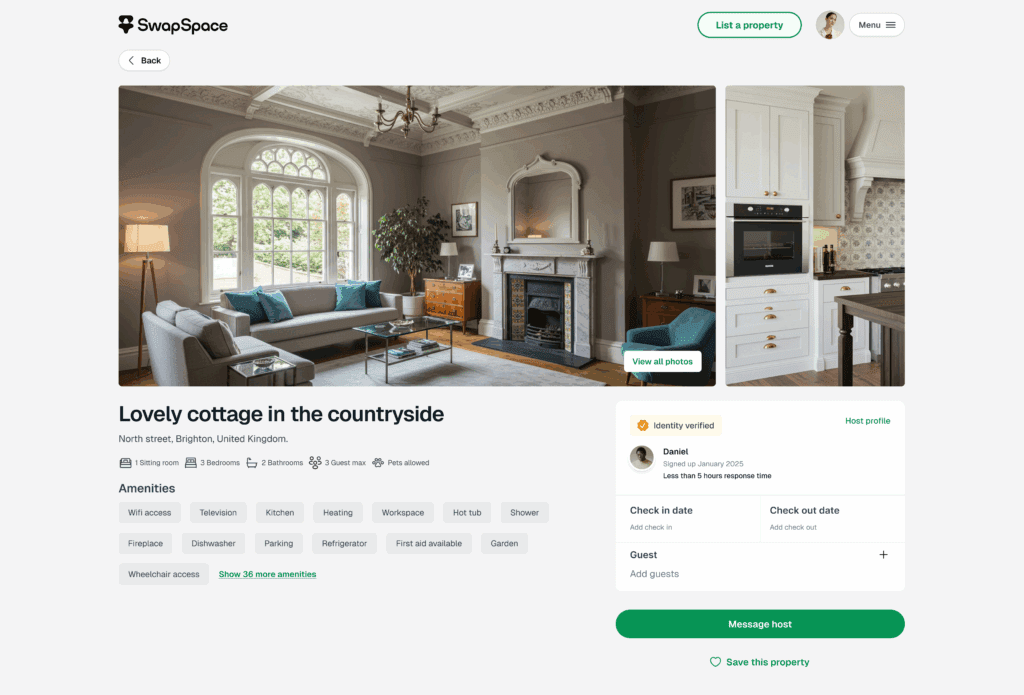
This is one reason the platform choice matters more than a stack of minor saving tips. A well-run exchange site can remove the nightly accommodation bill, but a community-led one also improves the quality of what replaces it. On a platform such as SwapSpace's home exchange community, the budget advantage comes from the structure itself: real member profiles, direct communication, and homes offered with context rather than sales language.
Community improves value, not just atmosphere
Short-term rentals are built around transactions. Home exchange works best when it is built around mutual confidence.
That changes how families book. Parents can ask practical questions without feeling awkward. Hosts tend to answer with the sort of honesty that helps, including the trade-offs. A fifth-floor walk-up may be fine for teenagers and a poor choice with a toddler. A beautiful rural house may be perfect if you plan to drive everywhere and inconvenient if you expect to rely on public transport. Good communities surface those realities early.
There is a trade-off here too. Community-led platforms can ask more of members. Profiles take longer to complete, messages require more care, and trust is built through responsiveness rather than instant booking. For families, that extra effort is usually worth it. Better information before the trip is cheaper than fixing problems once you arrive.
The result is simple. Budget family travel works best when the platform helps you choose well in the first place. A genuine community does exactly that.
5. 5. Effortless to Use A Platform That Simplifies Travel
Why do so many family trips blow the budget before anyone has packed a suitcase?
Often, the problem is not the destination. It is the booking process. A clumsy platform wastes time, hides good options, and pushes families back toward expensive default choices because they need something workable, fast.
That is why ease of use matters so much in home exchange. If the platform is the main budget decision, its tools need to help families reach a sound choice quickly. Search, calendars, messages, saved favourites, and clear house details are not cosmetic features. They are what stop a low-cost trip becoming an hours-long planning exercise that ends with a paid rental instead.
Good design cuts planning costs
Families book with practical constraints in mind. Bed layout matters. So does kitchen equipment, parking, stair access, and whether a host answers a message promptly.
A good exchange platform lets you filter for those realities without forcing you to decode half-finished listings. It should be easy to compare locations, check availability, and spot whether a home suits a family of five rather than merely sleeping five on paper.
I have found that the best platforms also reduce repeat admin. You should not have to rewrite the same introductory message for every enquiry or open five tabs to understand whether a swap is realistic. The more friction a platform creates, the more likely families are to abandon the exchange idea and pay for convenience elsewhere.
That trade-off is real.
Large families and multi-generational groups feel it first. A platform that works for a couple on a city break may fail completely when you are trying to match school holidays, grandparents, transport links, and enough communal space for everyone to live comfortably for a week.
What ease of use looks like in practice
The strongest home exchange platforms tend to get a few things right:
- Clear search filters: room count, child-friendly features, location, and timing need to be easy to sort
- Accurate calendars: families cannot plan around vague availability
- Detailed home pages: enough information to rule a property in or out quickly
- Straightforward messaging: direct contact without unnecessary steps
- Helpful planning support: practical advice that answers common questions before they become problems
That last point is underrated. Good guidance saves money because it helps families avoid weak matches, poor timing, and last-minute changes. SwapSpace does this well through its home exchange planning guides for families, which make the process clearer before you start sending requests.
An easy platform does not make travel feel flashy. It makes it feel manageable. For families travelling on a budget, that is what keeps the exchange model usable, and what turns one smart decision into meaningful savings.
5. 5. Effortless to Use A Platform That Simplifies Travel
Some travel platforms confuse activity with usefulness. Endless filters, awkward maps, slow messaging, cluttered calendars, and half-complete listings all create work for the user. Families don’t need more work.
A home exchange platform should reduce planning friction. If it doesn’t, people drift back to the familiar convenience of mainstream booking sites, even when those sites cost more.
Good design saves families time
Families are still determined to travel even under pressure. In the latest family travel data, 92% of parents said they were likely to travel with their children within the next 12 months, and 81% planned to increase or maintain their domestic travel spending, according to the 2025 Family Travel Survey. Demand isn’t the issue. Planning friction is.
A well-designed platform helps you answer the practical questions quickly. Can we fit everyone? Is there a kitchen? Is there outdoor space? Is it near transport? Can we message the host without starting from scratch each time?
That’s especially important for larger groups. Recent travel data also shows that 71% of grandparents have already taken a multi-generational trip and 57% plan to take one in the future, according to the Condor Ferries family travel statistics. Search tools need to work for real family complexity, not just couples looking for a weekend away.
The features that matter in practice
Ease of use sounds soft until you try to plan a trip with children. Then it becomes decisive.
Here’s what to test before committing:
- Search that reflects family reality: Bedrooms, beds, kitchens, outdoor space, parking, and child-friendly amenities should be easy to filter.
- Map clarity: Families need to understand location, not just admire interior photos.
- Straightforward messaging: If you’re juggling three possible swaps, the inbox should help rather than hinder.
- Listing quality control: A clean platform encourages complete, useful listings.
A practical example is simple enough. A parent looking for an October half-term stay in a specific part of London should be able to narrow results quickly to homes that suit four or more people, have the right sleeping setup, and are near the transport links they will use.
If you want to see how a platform supports members after signup, browse its help material as well as its listings. SwapSpace guides give a good sense of whether the platform is built for ordinary users or only for people willing to puzzle things out.
The best travel tools disappear into the background. You notice the trip, not the system.
That’s the standard to use. If the website feels like admin, your holiday starts badly. If it feels calm, legible, and sensible, family travel on a budget becomes much more realistic.
5-Point Comparison: Budget Family Travel Features
| Item | Implementation complexity | Resource requirements | Expected outcomes | Ideal use cases | Key advantages | Key drawbacks |
|---|---|---|---|---|---|---|
| 1. Verified Profiles: The Foundation of Trust | Medium, integrate ID checks, reviews and secure messaging | Moderate, ID verification service, secure storage, trust & safety staff | High trust and reduced fraud; greater peace of mind for hosts | Families, first-time swappers, child-safe exchanges | Strong accountability and reliable identities; safer swaps | Verification time and requirement to share personal ID |
| 2. Flexible Swaps: Travel on Your Own Terms | High, credit system, non-simultaneous booking logic | Moderate–high, credit accounting, matching algorithms, policy design | Greater travel flexibility and more booking options | Hosts with second homes, families with irregular schedules | Decouples hosting from travel; access to more destinations | Learning curve for credits; competition for peak dates |
| 3. Transparent Pricing: No Hidden Fees | Low, simple membership billing and clear T&Cs | Low, payment processing and basic support | Predictable costs and clear budgeting for families | Cost-conscious travellers and frequent swappers | No per-booking fees; easier budgeting; large potential savings | Upfront membership fee may deter occasional users |
| 4. A Genuine Community: More Than Just a Listing Site | Medium, application/invite flows, moderation tools | Moderate, community managers, forums, curated onboarding | Higher member quality, respectful exchanges and local insights | Families seeking authentic, respectful exchanges | Better conduct, meaningful connections, local tips | Smaller listing pool and perceived barrier to entry |
| 5. Effortless to Use: A Platform That Simplifies Travel | Medium, polished UX, search, messaging and calendar features | Moderate, UX/UI development, mobile optimization, reliable backend | Faster planning, easier discovery of family-friendly homes | Busy parents and users who prioritise simplicity | Saves time, precise filters, organised communications | Risk of prioritising aesthetics over deep functionality |
Your Checklist for Smarter Family Travel
Most advice about family travel on a budget focuses on trimming around the edges. Pack snacks. Skip peak meal times. Look for free museums. Those are useful habits, but they don’t address the largest cost in the room. Accommodation does. That’s why choosing the right home exchange platform is such an important decision.
The strongest platforms share five traits. They verify member identities properly. They give you flexibility through both direct swaps and credit-based stays. They keep pricing clear, so your savings aren’t eroded by checkout surprises. They feel like a community rather than a booking engine. And they’re easy enough to use that planning a trip doesn’t become a second job.
Those things matter because family travel is still a priority, even when budgets are tight. Parents are making careful trade-offs. Many are choosing accommodation with kitchens and adjusting the shape of their holidays to keep travel possible. That’s one reason home exchange can work so well. It aligns with how families already think when they want more space, more practicality, and a better hold on costs.
It also tends to produce a better style of stay. Children can spread out. Adults can cook. Grandparents can have a proper bedroom rather than a sofa bed in a cramped suite. You live in a neighbourhood instead of orbiting a lobby. For many families, that feels less like economising and more like travelling sensibly.
If you’re interested in broader low-cost trip planning, this ultimate family camping checklist is a practical companion. But if your goal is a major structural saving rather than a collection of small cuts, a well-run swap platform is often the better place to start.
SwapSpace fits the criteria outlined here rather naturally. It combines verified profiles, flexible SwapCredits, a members-only feel, and a clear exchange model that suits families who want more room and less financial strain. That doesn’t mean home swapping is right for every trip. It does mean that when family travel on a budget is the goal, picking the right platform is often the smartest move you can make before you choose the destination itself.
If you want a home exchange platform that keeps the essentials in view, SwapSpace is worth exploring. The mix of verified members, flexible SwapCredits, no service or cleaning fees, and a more curated community makes it a sensible option for families who want budget travel to feel comfortable rather than compromised.